
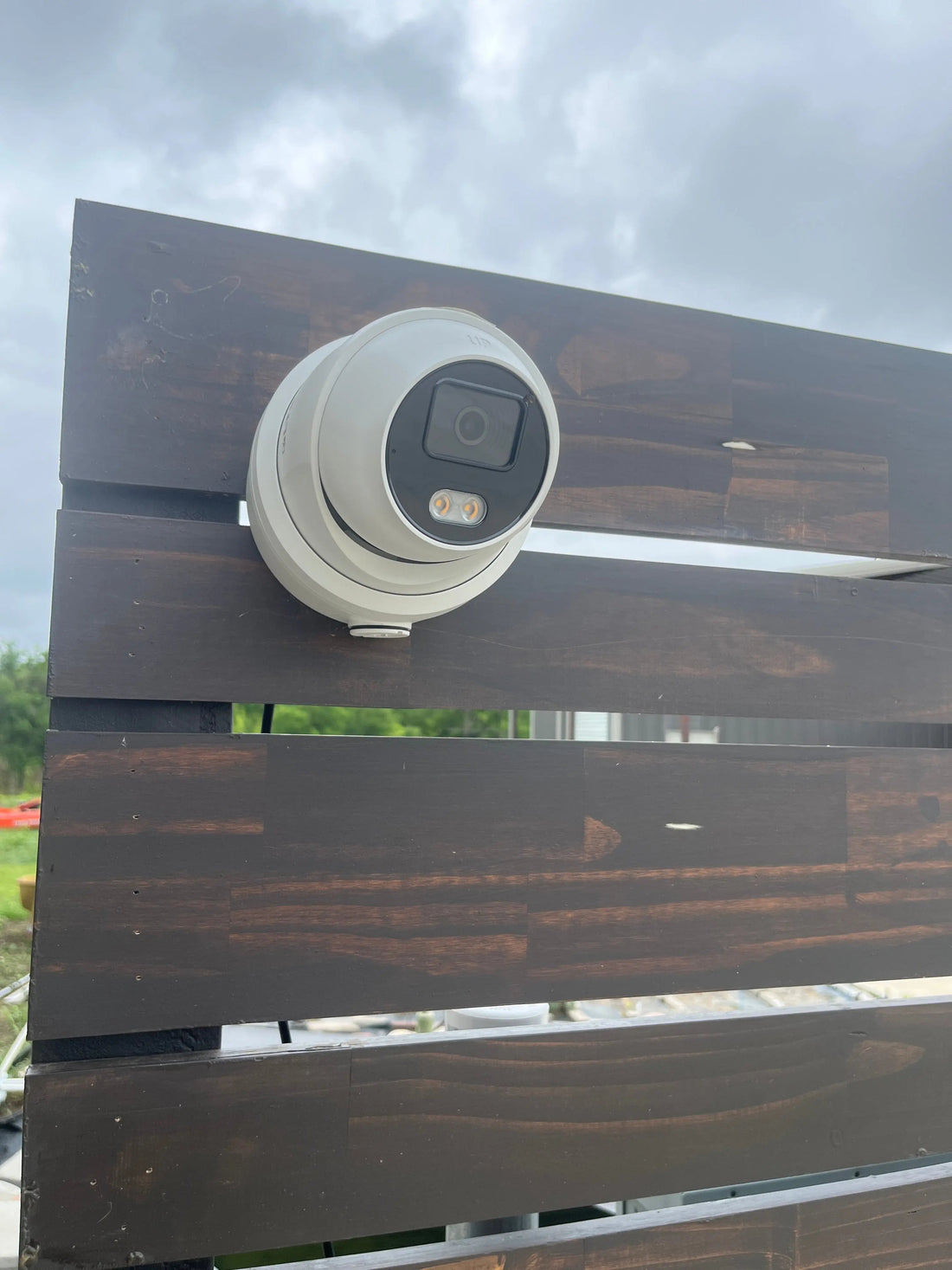
Turret Security Cameras for Outdoor Video Surveillance
Turret cameras are one of our preferred choices for outdoor and general-purpose video surveillance. Their exposed lens and infrared window are easier to clean and aim than many dome designs, and they avoid the internal infrared reflections that can occur when a dome cover becomes dirty, scratched or weathered.
Avenger Security commonly specifies turret cameras for Austin and Central Texas businesses when the mounting location, identification goal and environmental conditions make them the right fit. Bullet cameras are also useful when a longer lens, greater infrared range or more visible deterrent is needed.
What is a turret security camera?
A turret camera—sometimes called an eyeball camera—uses an adjustable camera ball held inside a compact mounting base. The lens can be aimed after installation without looking through a clear outer dome.
That open-face design offers practical service advantages:
- The lens and infrared window are easy to inspect and clean.
- There is no clear dome cover to create infrared glare when scratched or contaminated.
- The viewing direction can be adjusted during installation and future service.
- The housing has a lower profile than many traditional bullet cameras.
- Weather-rated models can work well beneath soffits, on walls and on approved junction boxes.
Why we often avoid dome cameras outdoors
Dome cameras can be appropriate in selected indoor locations, especially when the housing carries the required impact rating or the application benefits from a less obvious viewing direction. Outdoors, however, the clear cover can collect dust, water spots, insects and scratches. At night, those imperfections may reflect the camera's own infrared light back into the image.
A turret or bullet camera often provides a cleaner serviceable solution outdoors. Camera style should still be selected according to the actual scene, mounting height, weather exposure and vandalism risk.
Typical commercial turret-camera features
A common general-purpose commercial camera is a 4-megapixel PoE turret with a 2.8 mm lens, wide dynamic range, infrared illumination and a built-in microphone where audio recording is appropriate and lawful. The final specification may also include:
- IP66 or IP67 environmental protection.
- Onboard microSD storage for edge recording or connection-loss buffering.
- Wide dynamic range for entrances, windows and mixed lighting.
- Low-light or starlight imaging for difficult nighttime scenes.
- Audio input, output or built-in microphone.
- Analytics for motion, people, vehicles, line crossing or loitering.
- NDAA-compliant equipment when required by the customer or project.
An IP weather rating does not automatically mean a camera is vandal resistant. Where impact protection matters, the specified housing should carry an appropriate IK rating or be installed in a protected location.
Fixed lens or motorized varifocal?
A 2.8 mm fixed lens provides a broad view and works well for general coverage, entrances and many interior spaces. A motorized varifocal lens is better when the camera must be tightened onto a gate, driveway, loading area, cash point or other distant target.
Resolution alone does not determine whether the recorded image will identify a person or vehicle. Lens selection, scene width, mounting height, distance, lighting, compression and recording quality all matter. Every camera should be assigned a specific job before equipment is selected.
Mounting and nighttime performance
High mounting locations may show the top of a person's head instead of a useful face. Cameras aimed across a large bright-to-dark scene can also lose important detail. During design and installation, we consider:
- The identification distance and width of the target area.
- Available visible and infrared lighting.
- Headlights, glass doors, windows and backlighting.
- Rain, insects, landscaping and reflective surfaces.
- PoE cable distance, surge exposure and network capacity.
- Required retention and recording resolution.
- Whether audio is appropriate for the location.
Local recording, network video and cloud management
Traditional closed-circuit television, or CCTV, describes a closed local video system. A camera system connected to mobile applications, internet services or cloud storage is more accurately described as network video surveillance or cloud-managed video.
Turret cameras can be used with a local recorder, a cloud-managed video bridge or a hybrid design. Cloud management can provide remote viewing, health alerts, user controls and off-site access to recorded video. Local or edge recording may support higher-quality evidence, resilience or specialized retention requirements.
Read our business video surveillance guide for more about Eagle Eye Networks, remote access, system health and optional human-reviewed monitoring.
Maintenance matters
Even a properly installed camera needs periodic attention. Lenses and infrared windows should be cleaned, views checked after landscaping or construction changes, and recorded playback reviewed to confirm useful image quality. A camera that appears online can still have a blocked, poorly focused or poorly illuminated view.
Managed video services can help identify communication, recording and storage problems, but physical inspection remains important.
Request a video-surveillance assessment
Avenger Security designs and supports video-surveillance systems for Austin and Central Texas properties. Visit our video surveillance services page to discuss camera types, mounting locations, recording, retention and remote access for your facility.