Layered Business Security Systems for Austin Companies
A dependable business security plan is built in layers. Burglar alarms, access control, video surveillance, fire alarm systems, and professional monitoring perform different jobs. The strongest design coordinates those systems where appropriate without treating one technology as a substitute for another.
Avenger Security helps Austin and Central Texas businesses evaluate existing equipment, correct weak points, and build practical systems that can expand as the facility changes.
Begin With the Property and Its Risks
Security equipment should be selected after reviewing how the building is actually used. A professional assessment considers:
- Public, employee, delivery, and after-hours entrances
- Doors that are forced open, propped open, or difficult to secure
- Cash, inventory, medication, records, tools, and other protected assets
- Opening and closing procedures
- Interior areas requiring restricted access
- Camera views, lighting, identification distance, and retention requirements
- Existing alarm, access-control, fire-alarm, network, and door-hardware conditions
- Emergency contacts, dispatch instructions, and escalation procedures
Layer 1: Commercial Burglar Alarm
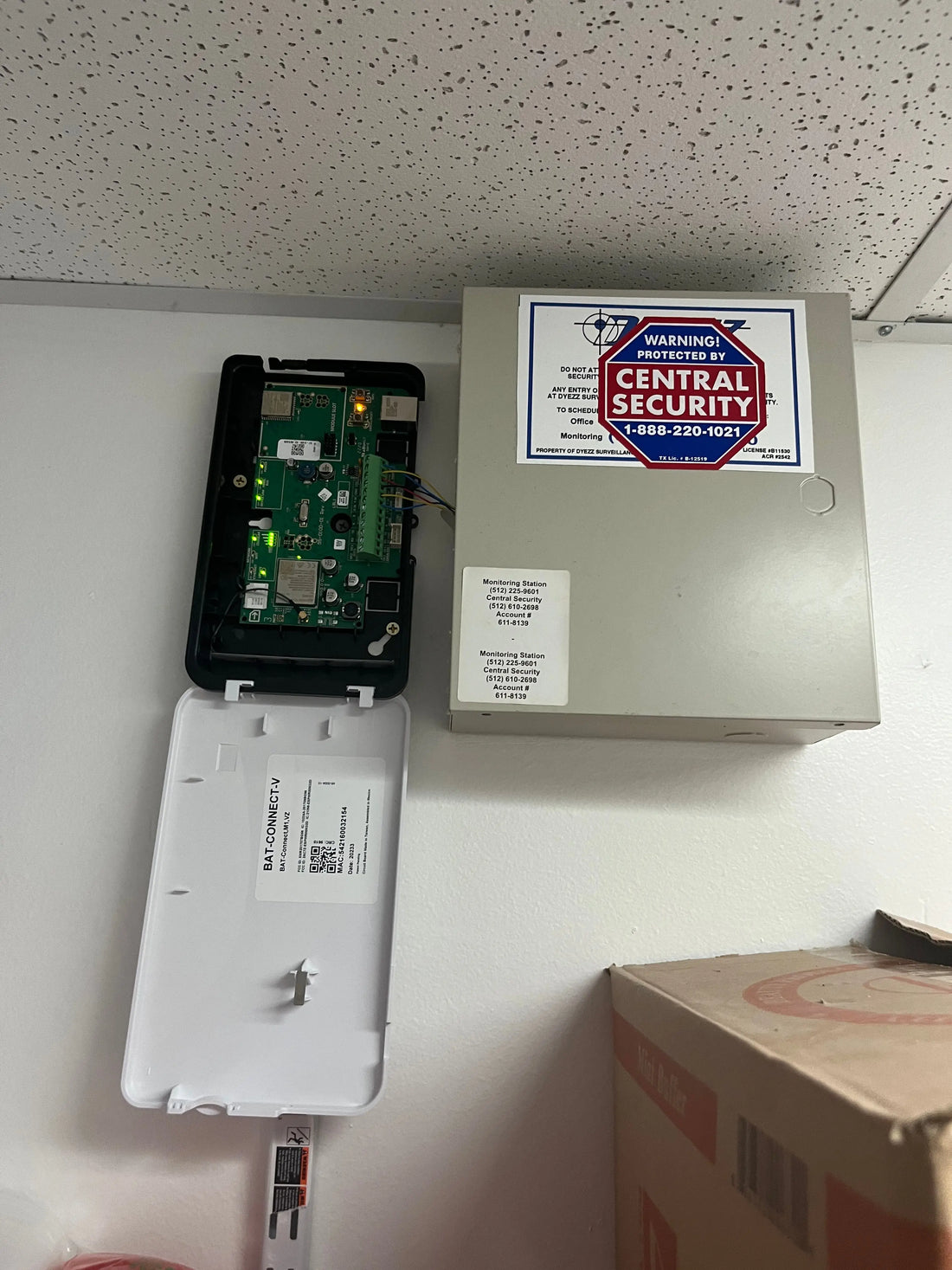
A commercial burglar alarm detects unauthorized entry and reports alarm, trouble, opening, closing, and other programmed events. A well-designed system may include door contacts, motion detectors, glass-break detectors, panic buttons, tamper protection, sirens, and LTE or dual-path communication.
Existing professional alarm systems can often be reprogrammed or upgraded instead of completely replaced. Avenger Security evaluates the panel, wiring, sensors, communicator, battery, and central-station reporting before recommending new equipment.
Layer 2: Cloud-Managed Access Control
Access control manages who can enter, which doors they can use, and when their credentials are valid. Cloud-managed systems such as Brivo can support cards, fobs, PINs, and mobile credentials across one or multiple locations.
The door hardware remains critical. Standard commercial openings should generally use fail-secure electric strikes, electrified locksets, or motorized latch-retraction hardware where appropriate. Required egress must remain available from the inside.
Door-position monitoring should report forced-open and propped-open conditions. Access logs should show the credential, door, time, and result of each event.
Learn more about commercial access-control systems.
Layer 3: Video Surveillance
Video surveillance should provide clear, usable evidence—not simply show that a person was present. Camera type, mounting location, lens, lighting, resolution, frame rate, retention, and network design should match the scene and the customer's purpose.
Avenger Security recommends properly selected outdoor turret or bullet cameras instead of defaulting to domes in exposed locations. Cloud-managed video through Eagle Eye Networks can provide remote viewing, health monitoring, event search, and scalable retention.
Video can also support access-control and alarm events by helping identify who used a door, why an alarm occurred, or whether dispatch is appropriate.
Review managed video-surveillance options.
Layer 4: Commercial Fire Alarm
A fire alarm is a regulated life-safety system with separate licensing, inspection, testing, monitoring, documentation, and AHJ requirements. It should not be treated as another burglar-alarm feature.
Commercial fire-alarm design may include initiating devices, notification appliances, sprinkler supervision, duct detection, elevator functions, controlled-egress release, communicator supervision, annual inspection, and required reporting to the authority having jurisdiction.
Any coordination between fire alarm, access control, elevators, and locking hardware must follow the approved sequence of operation and be tested as a complete life-safety function.
Learn more about commercial fire-alarm service and monitoring.
Professional Monitoring and Event Reporting
Professional monitoring connects the installed systems to trained operators who process events according to the customer's call list and dispatch instructions. Full event reporting can give managers a clearer record of alarm, restore, trouble, supervisory, opening, and closing activity when supported by the equipment.
Avenger Security uses a UL-listed central station and offers security monitoring without requiring a long-term contract or credit check. Customers may cancel service with 90 days' notice.
Review available alarm-monitoring options.
Integration Should Improve Accountability
Integration is valuable when it produces a clear and testable result. Useful examples include:
- Video associated with a forced-door or alarm event
- Authorized credential activity coordinated with a burglar-alarm partition
- Door-prop alerts sent to the responsible manager
- Alarm.com notifications and remote system management
- Centralized user schedules across multiple locations
Integration should not eliminate required mechanical egress, bypass fire protection, or create unexplained automated actions. Each system must continue to perform its primary function safely and reliably.
Service, Documentation, and Long-Term Support
A business security system will eventually require service. Doors change, networks are modified, devices fail, employees leave, and facilities expand. Keep accurate zone lists, door names, camera names, user groups, emergency contacts, passwords, drawings, and inspection records.
Avenger Security provides design, installation, system takeovers, programming, monitoring, repair, and expansion support across Austin, Central Texas, and other Texas service areas.
New-service consultation: New clients considering new services receive an on-site visit and up to one hour of consultation at no cost. Troubleshooting, diagnostics, repairs and other technical service on existing systems are billed at standard service rates; when applicable, the standard on-site service visit is $195.