Commercial Access Control Systems: Hardware, Wiring and Cost Factors
A commercial access control system should do more than unlock a door. A well-designed system identifies who presented a credential, confirms whether the door opened, records the event and alerts the right people when a door is forced or held open. The correct design starts with the door and its life-safety requirements—not with a reader or a software subscription.
Avenger Security designs access control for Austin-area businesses around the opening as a complete system: the door, frame, lock, exit hardware, reader, controller, power, cabling, network connection and operating procedures. This guide explains the main components and the factors that affect installation cost.
Start with the door and existing hardware
Every opening must be surveyed before hardware is selected. Door material, frame construction, handing, latch type, fire rating, panic hardware and the path of egress all affect what can be installed. A storefront aluminum door may need a different solution than a hollow-metal office door, a glass entrance or an exterior gate.
For many standard commercial doors, we generally prefer positive-latching hardware that keeps the door secure during a power interruption while preserving code-compliant mechanical egress from the inside. Common options include:
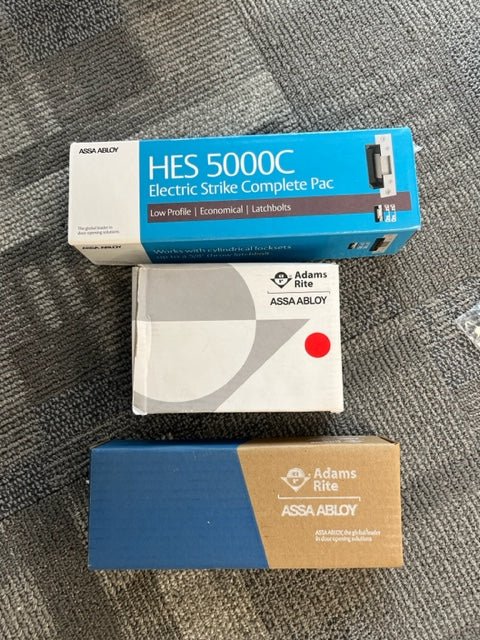
- Fail-secure electric strikes that release the latch when access is granted.
- Electrified locksets when the lock itself is the best point of control.
- Motorized latch retraction or electrified panic hardware for doors equipped with exit devices.
Magnetic locks can be appropriate for certain special applications, but they require careful coordination of release devices, fire alarm interfaces, power and egress rules. They should not be treated as a universal answer. Final hardware and release arrangements must follow the approved plans, listed equipment and the authority having jurisdiction. For more detail, see our guide to fail-safe and fail-secure door hardware.
The components of a complete access-controlled opening
Controller and software
The controller makes the access decision and records activity. Depending on the system, management may be hosted on-site or in the cloud. The platform should support practical administration: adding or disabling users, assigning schedules, reviewing events and managing multiple doors or locations without unnecessary complexity.
Reader and credentials
The reader should match the credentials the organization intends to use now and in the future. A dual-credential reader can support secure cards or fobs alongside mobile credentials, which provides a practical migration path and reduces dependence on a single credential format. Learn more about access control credential options.
Locking and exit hardware
The lock must work with the door's existing latch and exit hardware. Occupants should retain the required means of egress. On mechanically free-egress doors, a request-to-exit device is commonly used to monitor egress and suppress a door alarm—not as the only method a person depends on to unlock and leave.
Door-position monitoring
A door-position switch tells the system whether the door is actually open or closed. Without it, the controller may know that access was granted but not whether the door opened, remained propped or was forced. Proper monitoring makes door-held-open and forced-door alerts possible and improves the usefulness of the audit trail.
Power, cabling and network
Reliable operation depends on correctly sized power supplies, protected low-voltage wiring and a stable network connection where cloud management is used. Cable pathways, conduit, ceiling access, distance to the control panel and coordination with other trades can materially change the work required.
What affects access control installation cost?
There is no responsible flat price that applies to every door. A useful proposal should identify the equipment and labor for each opening and explain any assumptions. Major cost factors include:
- Door and frame condition, material and fire rating.
- Existing lock, latch, panic hardware and door closer.
- The selected strike, electrified lockset or exit-device solution.
- Reader type and credential technology.
- Door-position, request-to-exit and other monitoring devices.
- Controller capacity, power supplies and enclosure requirements.
- Cable distance, conduit, difficult pathways and after-hours work.
- Cloud licensing, cellular backup or ongoing service options.
- Permitting, inspections and required coordination with fire or life-safety systems.
An inexpensive quote can become costly when it excludes door repair, required egress hardware, conduit, permits or software fees. A site survey helps turn those unknowns into a clear scope before installation begins.
Security features worth specifying
A modern access control system should support more than basic entry. Useful capabilities include schedules, immediate credential deactivation, remote administration, detailed event history and alerts for a forced or propped door. When integrated thoughtfully with video or intrusion detection, an access event can also help operators find the corresponding camera footage or investigate an alarm.
For higher-security openings, consider layered authentication, protected controller locations, supervised inputs and a documented process for credential issuance and removal. Technology is only one part of the system; enrollment, permissions and offboarding procedures determine whether access remains accurate over time.
Plan for code compliance and future expansion
Access control must never be designed in isolation from fire and life-safety requirements. The permitted arrangement can vary with the occupancy, door type, exit path and adopted code. Avenger Security coordinates the security design with the approved plans and the appropriate contractors and authorities so that access control does not compromise required egress.
It is also wise to reserve controller capacity, enclosure space and cable pathways for likely growth. Adding a second phase is simpler when expansion was considered during the first installation.
Plan your Austin access control project
Avenger Security can assess the doors, recommend suitable hardware and prepare a scope that separates one-time installation from optional ongoing services. Visit our business security solutions page to discuss access control, intrusion detection, video surveillance and professional monitoring for your facility.