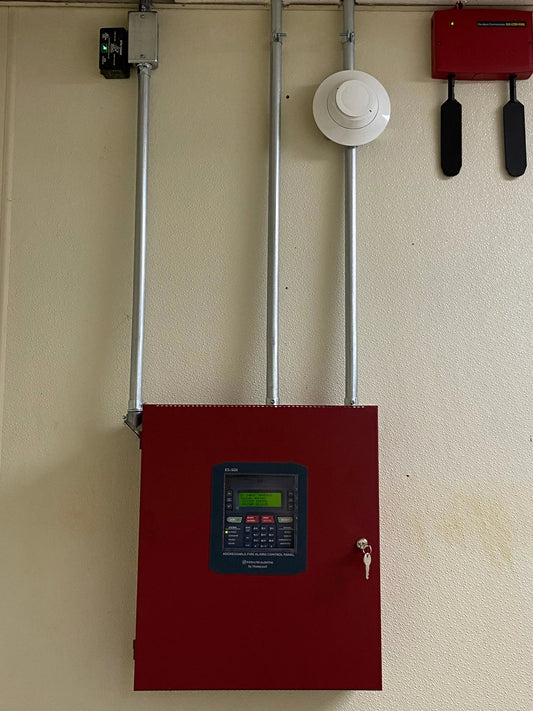
Texas Limits on Local Security and Fire Alarm Regulation
Statutory references and official source links checked October 5, 2026: Texas DPS §1702.134 guidance and Texas Insurance Code §6002.003.
Texas law limits some local requirements imposed on state-licensed private-security and fire-alarm companies, but those limits are not a blanket exemption from customer alarm permits, project permits, building codes or authority-having-jurisdiction requirements. Two statutes are especially important: Texas Occupations Code §1702.134 and Texas Insurance Code §6002.003.
Informational notice: This page is a practical overview, not legal advice. Confirm the current statute, adopted codes, permit requirements and project interpretation with the applicable state agency, authority having jurisdiction and legal counsel.
Texas Occupations Code §1702.134
This section addresses state-licensed private-security companies and their employees. In general, it says a company license holder or its employee is not required to obtain another local authorization, business permit, franchise or license, pay another local fee or franchise tax, or post a local bond merely to engage in business or perform a service authorized by Chapter 1702.
The statute also limits charges for the use of public facilities connected with those services, while allowing specified exceptions. Those exceptions include a reasonable municipal charge for use of a qualifying central alarm installation in a police office and reasonable inspection or reinspection fees for a device that causes at least five false alarms within 12 months.
A municipality may also require discontinuation of service for an alarm-signal device that causes at least five false alarms in 12 months because of mechanical malfunction or faulty equipment until the device is repaired to the satisfaction of the appropriate official. The statute excludes false alarms caused by human error or an act of God from that malfunction provision.
Read the Texas Department of Public Safety summary and statutory text.
What §1702.134 does not mean
The section protects a qualifying company license holder from certain additional local business-authorization requirements. It does not say that an alarm user may ignore a city alarm-user permit, false-alarm ordinance or response fee. It also does not eliminate permits and approvals that arise under a different statute or apply to a property, construction project, fire alarm or life-safety system.
Texas Insurance Code §6002.003
Section 6002.003 governs the effect of local regulation on fire detection and alarm work. Chapter 6002 and its rules have uniform statewide effect, and a municipality or county may not enact a rule that conflicts with them.
The same section preserves several important local powers. A municipality or county may, within the statute’s boundaries:
- Require a fire alarm or detection system in specified facilities when the installation conforms to state law.
- Require a better type of alarm or detection system, or an otherwise safer condition, than the state minimum.
- Require regular local inspection of smoke alarms in dwelling units and require them to be operational.
- Require a registered fire-alarm firm to obtain and pay for an installation permit.
- Require the installation to comply with applicable building codes, construction requirements and state law.
- Require proof of the firm’s state registration certificate.
- By ordinance, require a monitored-property telephone call before notification to the municipality or county of a signal from a fire-detection device.
However, the section restricts a political subdivision from imposing separate local business registrations, franchise licenses, fees, franchise taxes, bonds, added qualification or financial-responsibility requirements beyond the permitted proof, or a local office or residency requirement as a condition of performing work authorized by Chapter 6002.
Read the current Texas Insurance Code Chapter 6002.
Practical project takeaway
- Separate the contractor’s state license from the property owner’s alarm-user permit.
- Separate a company’s right to perform regulated work from the project’s installation permit and plan review.
- Verify the adopted fire, building and accessibility codes for the specific address.
- Obtain the permits and approvals the controlling statute allows the authority having jurisdiction to require.
- Document disputed requirements and ask the authority to identify the ordinance, code section or statute supporting them.
For help coordinating an alarm or fire-alarm project, contact Avenger Security.
For the related services, see home alarm monitoring and commercial fire-alarm service and monitoring.