
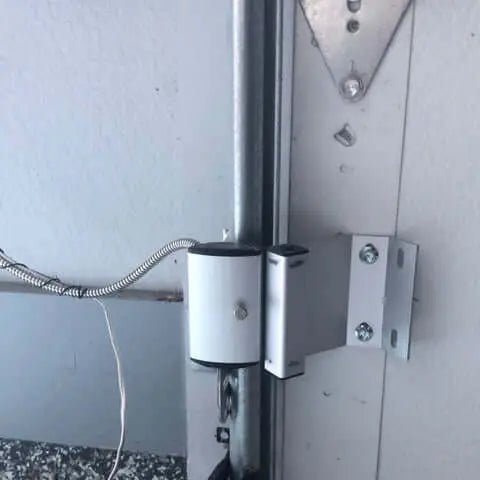
Connecting an Overhead Garage Door to a Home Security System
An overhead garage door is one of the largest and most frequently used openings in a home. Connecting it to the security system can provide door-position monitoring, open-door alerts, alarm protection, and a clearer picture of whether the property was secured when the system was armed.
Monitoring the position of a garage door is different from controlling the garage-door operator. Both can be useful, but they require different equipment and programming.
Why Monitor an Overhead Garage Door?
A properly installed contact allows the alarm system to determine whether the overhead door is open or closed. Depending on the system and service, the customer may receive:
- An alarm if the door opens while the system is armed
- A notification when the door is left open
- Event history showing when the door opened and closed
- A warning when attempting to arm while the door remains open
- Remote status through a compatible Alarm.com application
Recommended Door-Position Devices
Rail-Mounted Magnetic Contact
A heavy-duty or wide-gap magnetic contact mounted at the garage-door rail is often the most dependable option. The contact and magnet should be positioned where normal door movement will not damage the wiring or hardware.
When a usable cable already reaches the door, the contact can connect directly to a compatible hardwired alarm zone.
Wireless Transmitter With an External Contact
When no alarm cable is available, a compatible wireless transmitter with an external wired input can connect to a rail-mounted magnetic contact. For DSC PowerSeries Neo systems, an appropriate PowerG transmitter may be used after verifying panel, receiver, and device compatibility.
Tilt Sensor
A purpose-built wireless tilt sensor can identify whether a sectional garage door has moved from its closed position. Tilt sensors can simplify installation, but battery condition, mounting orientation, vibration, and exact device compatibility must be considered.
Entry Delay Should Match How the Garage Is Used
There is no universal 120-second entry delay for every garage door. The correct delay depends on where the keypad is located, how occupants enter, whether app-based disarming is used, and how long it reasonably takes to reach the disarming point.
The delay should be long enough for normal entry but not unnecessarily long. If occupants routinely enter through the garage, a keypad near the interior garage entry or a secure interactive disarming method can reduce false alarms.
Force Arming and Open-Door Exceptions
Some systems can be programmed to allow arming while the garage door is open and automatically restore protection after the door closes. This feature is sometimes called force arming or automatic bypass restoration.
It should be configured deliberately. Customers must understand whether the door is temporarily bypassed, when protection becomes active, and what notification occurs if the door never closes.
Monitoring Is Different From Operator Control
An alarm contact reports whether the door is open or closed. It does not automatically provide remote opening and closing. Operator control requires a compatible garage-door controller or an approved interface with the existing operator.
Remote-control integration must not bypass the operator's photo eyes, safety edge, entrapment protection, travel limits, or other required safety features. The garage-door operator should retain its normal listed safety functions.
Recommended Programming and Testing
- Use a zone definition appropriate for the actual entry and arming sequence.
- Confirm whether the zone is active in Stay, Away, and Night modes.
- Test open, closed, alarm, restore, bypass, and tamper events.
- Place the central-station account on test before intentionally generating signals.
- Verify app alerts and event history when interactive service is included.
- Confirm the contact remains aligned throughout the full movement of the door.
Professional Garage-Door Alarm Integration
Avenger Security can inspect the existing alarm panel, select an appropriate contact or wireless transmitter, program the zone, and verify reporting through the central station. We can also review compatible Alarm.com garage-control options when remote operator control is requested.
Contact Avenger Security for help monitoring an overhead garage door.